
The Road Holds the Story
A first journal entry, a photograph from my first digital camera, and why Guildmark begins by paying attention to the path.
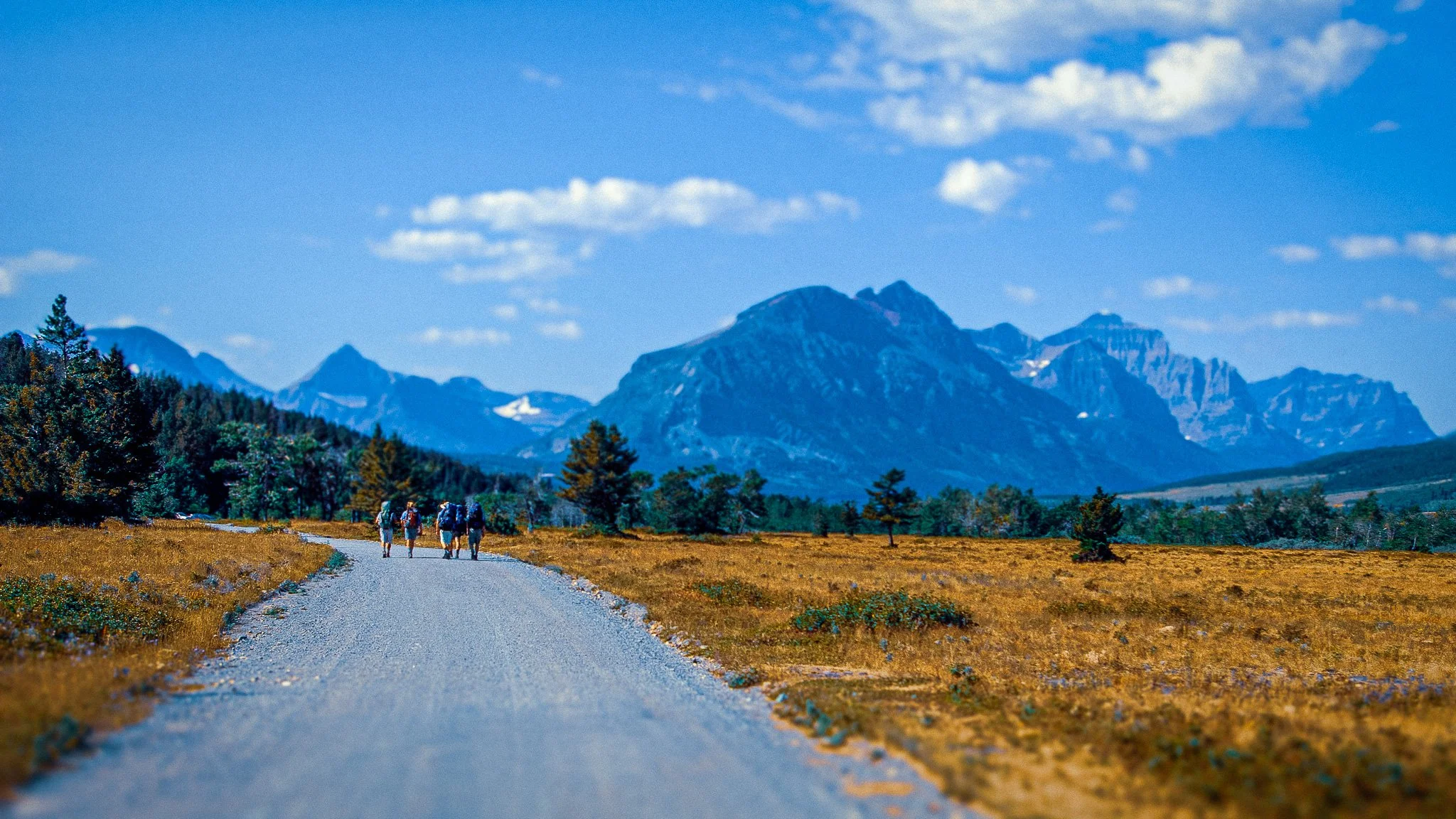
Glacier National Park, August 2008. Made with my first digital camera while I was still working primarily with film. The mountains mark a destination; the road holds the story.
In August 2008, I was on a backpacking trip in Glacier National Park with a group of friends. Somewhere along a gravel road, with the mountains still miles ahead, I set up the camera, started the timer, sprinted ahead to rejoin the group before the shutter fired. The result is this image of us walking toward our destination.
At first glance, the mountains appear to be the subject. They are large and bright under a wide sky. Look a little longer, and the photograph shifts. The hikers are small against the landscape, but they give the image meaning. The road carries the eye toward them and then onward to the peaks.
That is what the image is really about, and it is why I chose it to open this Journal: photography can preserve a destination, but it can also reveal the meaning of the journey.
A Camera I Was Still Learning
This photograph came from my first digital camera, a small, low-resolution point-and-shoot. At the time, I was still making most of my serious work with film cameras. I carried the little digital camera as an experiment–to see what it could do, where it fell short, and whether it could earn a place in how I worked.
Without the cost of film and processing, I could test ideas I might otherwise have hesitated to spend a frame on. I could see a result, adjust, and try again. The files held less detail than I was used to, and they gave me less room to recover from mistakes. I was not shooting RAW yet; I was still discovering how much I had to learn about digital photography. The camera asked me to pay closer attention to exposure, focus, and composition.
Looking back, those limitations were useful. They pushed me toward the decisions that matter regardless of the equipment: where to stand, what to include, where to place attention, and what the photograph is meant to say. This photograph’s value does not depend on technical perfection. It comes from the choices that shape its meaning. The tools we use change. The questions underneath them do not.
The Destination Is Only a Moment
This was one of many backpacking trips we took together in Glacier over the years. Each had a destination: a lake, a pass, a campsite, or simply the end of that day’s miles. Reaching those places mattered. Arrival brought relief, satisfaction, and sometimes an extraordinary view.
But arrival was always brief compared with everything it took to get there. Most of each trip happened along the way, in the miles walked, the weight carried, the decisions made, and the time shared. I do not remember every mile of that day, but I remember the rhythm of walking together and the way the conversation came and went as the road stretched toward the mountains.
Those miles were not the price of the meaningful part. They were the meaningful part.
A destination gives the journey direction, but it cannot hold all of its value. If we save our satisfaction for arrival, most of life becomes time to get through while we wait for a few brief moments of accomplishment.
Photographs work the same way. Each one carries something of its maker’s journey.
The finished work marks a moment. The journey reveals what that moment means.
Most Finished Work Hides Its Beginnings
A photograph does not show the decisions made before the shutter was released. It does not show the camera the photographer was still learning, the frames that did not work, or the years of practice behind a simple choice about focus. A handmade object rarely shows the failed attempts, revised ideas, or knowledge held in the hands of its maker.
We usually encounter the finished work without seeing everything that made it possible.
Guildmark has beginnings like that, too. It started as a set of questions rather than a finished plan:
· What makes a photograph meaningful beyond its immediate beauty?
· How can photography honor the work, knowledge, and character of a maker?
· What can we learn when we slow down and examine how something was created?
· What kind of place could bring commercial photography, education, craftsmanship, and storytelling together?
Those questions have shaped everything that followed.
Where the Work and the Teaching Meet
Guildmark is a working photography studio. It creates images for businesses, makers, and people who want their work seen with care. It is also a place to teach, because the thinking behind a good photograph is worth sharing.
Those two sides strengthen each other. Commercial work keeps the craft honest because an image has to communicate for a real client with a real purpose. Teaching keeps the craft examined because explaining a decision to someone else forces me to understand why I made it. The exploration that started with an early digital camera on a gravel road continues in both.
Photography is a visual language. Light, framing, color, timing, focus, and point of view all change what an image says. Learning to use that language deliberately is the work of a lifetime, whether the camera is film or digital, old or new.
Why Begin a Journal
A finished gallery shows results. The Journal is where the path stays visible.
Here I will look at the choices behind individual images, share lessons on light and composition, work through critiques, and write about makers and the quiet knowledge that develops through years of practice. Some entries will be full essays. Others will be field notes, image studies, or observations gathered while working. Some will be about tools and techniques. Most will be about seeing.
I do not want this Journal to become a stream of content created simply because something new is expected. Each entry should give you a reason to look more closely, think more carefully, or approach your next photograph with more intention.
Guildmark is still developing, and that development belongs in its story. The name, identity, website, and educational focus have required refinement and more than a few changes in direction. Waiting until everything felt complete would miss the most important part: the making of it.
What You Will Find Here
· Photography as a visual language through light, composition, color, and meaning
· How photographs and projects develop, including what does not work
· Constructive critique and the process of improving creative work
· Tools and techniques and what they teach us about seeing
· Makers, materials, and working spaces
· Behind the scenes on commercial projects
· Photography as a record of place, friendship, memory, and lived experience
What connects them is attention: to how something is made, to what an image communicates, and to the decisions that shape the work.
A Marker Along the Way
This first entry is not a declaration that Guildmark has arrived. It is a marker placed along the road.
The Glacier photograph is a marker too. It holds one road, one group of friends, one camera I was still learning to use, and one brief moment within years of shared journeys. Its value has grown not because it shows a destination reached, but because it reminds me how much of the story was found while we were still moving.
There will be other destinations: finished photographs, published stories, workshops, client projects, and new bodies of work. Each will deserve recognition. None will be the end of the story.
If you are a photographer, a maker, a student of the visual arts, or someone who believes meaningful work deserves closer attention, I hope you find something worthwhile here.
Look closely. Make thoughtfully. Value the experience as much as the outcome.